
Change Management
ABC Power
Business: ABC Power Company (pseudonym)
Business Unit: Nuclear Operations, Training Support
Project: Training Completion Entries by Instructors
Change Identification
The project shifts responsibility for entering training activity completions into the Learning Management System (LMS) from a team of seven Learning Development Representatives (LDRs) to the approximately 120 instructors who deliver the training. Instructors enter completions during the normal flow of instructional delivery, then submit hard-copy records to LDRs for long-term retention.
Problem Statement
ABC Power Company, a Southeast U.S. electricity provider, faces rising demand for clean baseload power alongside borrowing restrictions and rate caps that limit new revenue. An external efficiency review identified duplicate LMS data entry as one of several internal inefficiencies. The current process of instructors handing records to LDRs, who then key them into the LMS consumes roughly 4.3 hours per LDR per week and slows access to training records that instructors already have in hand.
Cost of Change
| Project cost (CBT, access provisioning, info session) | $6,000 |
| Change variables (lost productivity, first 4 months) | $31,200 |
| Total cost of change | $37,200 |
| Annual labor savings (~$8,600 × 7 LDRs) | $60,200 |
| Year-1 ROI | 1.62 |
Change Approach
My team selected PROSCI ADKAR for its fit with a large-scale rollout that offers limited room for customization at the individual level. Key risks identified during analysis included LDR resistance tied to perceived loss of responsibility, instructor pushback framing the change as scope creep, and broader change saturation following six months of prior organizational shifts. Mitigation centered on framing LDR time as redirected (to audits, exam record entries, and quality checks) rather than eliminated, and positioning instructors as full owners of a process they already lead.

Strategy and Roadmap
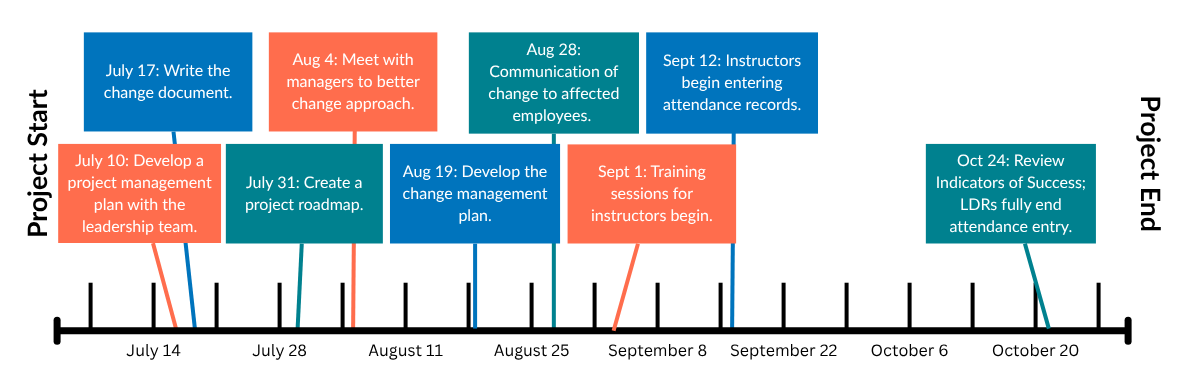
The project ran from July 10 to October 24, 2025. Planning and stakeholder alignment occupied July and August, employee communication landed on August 28, instructor training began September 1, instructors went live on September 12, and LDRs fully ceased the specified entries on October 24, when success indicators were reviewed.
| Stakeholder | Disposition | Strategy |
|---|---|---|
| LDRs (n=7, unionized) | Resistor | Reinforce remaining duties and continued value; route messaging through union rep |
| Instructors (n=~120) | Mixed (~half already perform the task) | Frame as ownership of an existing workflow; highlight real-time credit and fewer follow-ups |
| Union Representative | Neutral | Confirm no headcount or core-duty reduction |
| Managers / Senior Leadership | Proponent | Equip with talking points; lead employee-facing meetings |
Communication and Training
The communication strategy was built around a core insight from the stakeholder analysis: the same change carried very different meanings for each group, and a single message would either reassure no one or alienate everyone. I developed audience-specific framings that addressed each group's underlying concern directly rather than talking around it.
| Audience | Underlying Concern | Reframe Used |
|---|---|---|
| LDRs | "This is the first step toward eliminating my role." | Time is being redirected, not removed. The work that remains (records custody, audits, exam record entries, quality checks) is the higher-value half of the role, and freeing capacity for it is the point of the change. |
| Instructors (new to LMS) | "This is extra work that isn't in my job description." | The entry happens while the roster is already open, eliminating a handoff rather than adding a step. Real-time credit and fewer follow-up emails are the direct, near-term benefit. |
| Instructors (already entering) | "Why is this being announced as a change? I already do this." | Positioned as formal recognition of an existing best practice, with these instructors implicitly cast as the model for the rest of the team. |
| Union Representative | "Are represented employees losing duties or headcount?" | Explicit confirmation that core duties and staffing remain intact. The union was briefed before the broader announcement so they could speak from a position of information rather than reaction. |
| Managers | "How do I handle pushback in the room?" | Equipped with talking points that acknowledged the resistance as legitimate ("we anticipate this will be met with resistance") rather than scripting it away, paired with the company-level rationale (efficiency funding future capacity) to anchor the conversation upward when it got stuck. |

Indicators of Success
100% of instructors complete the CBT and request LMS access before go-live
70% complete the information-sharing session within 1 week of implementation; 100% within 2 weeks
70% are entering their own completions within 4 weeks; 100% within 6 weeks
Deliverables Produced
Problem and impact analysis
ADKAR-based change approach, cost-of-change model
Stakeholder impact matrix
Communication and training plans
Manager talking points
Employee notification email
Visual change roadmap
References
Hiatt, J. M. (2006). ADKAR: A model for change in business, government, and our community. Prosci Learning Center Publications.
Prosci. (n.d.). The Prosci ADKAR model. Prosci. https://www.prosci.com/methodology/adkar