
Current & Future State Analyses
Top Power University
Note: Top Power University is a pseudonym. Proprietary metrics and key information were anonymized. The current state analysis was completed approximately one month before the future state analysis began.
Current State Analysis
Evaluate the current state of Top Power University by analyzing its external environment, strategy, leadership, and employee life cycle, offering insights into different aspects of the current state of TPU.
Methods
To ground the investigation in business reality, my team structured the analysis using the Business Logics Model. This framework allowed us to move beyond the typical Learning & Development lens and evaluate the organization through different business perspectives.
To understand the leadership structure and the current culture that influences decision-making, the team assessed the organization using the Organizational Culture Assessment Instrument (OCAI).
To evaluate the efficiency of the curriculum development lifecycle, the team employed process mapping.
Frameworks & Models
Organizational Overview
Top Power University is an industry-leading private for-profit vocational technical college headquartered in the Northwest United States of America.
Founded in 1993 by journeyman lineworkers
15-week pre-apprenticeship program
Acquired by Big Power Services (pseudonym) in 2018
-
A model that assists performance consultants in viewing an organization through a business lens rather than just a training lens (Silber & Kearny, 2006). It structures analysis across seven distinct dimensions.
External
Economic
Strategic
Product
Customer
Process
Internal
This ensures that any proposed solution aligns with the organization's financial realities and strategy, rather than just its educational goals.
Note: This tool is used by the performance consultant to understand the organization, but it is not intended for client presentation.
-
The OCAI uses a series of questions to assess the firm’s six key dimensions of organization culture: dominant characteristics, organizational leadership, management of employees, organizational glue, strategic emphasis, and criteria of success (Cameron & Quinn, 2011). Once each section is completed, the numbers from the sections are added to the scoring section and averaged so the organization’s dimensions can be mapped onto the Competing Values Framework.
External Environment
Market Stability & Growth: The lineworker industry is projected to see stable 8% annual growth through 2033, driven largely by the retirement of an aging workforce (U.S. Department of Labor, 2024). State-specific data for TPU's key markets (California and Texas) indicates even higher demand, with projected growth rates of 12.5% and 12.1%, respectively (Projections Central, 2024).
Competitive Landscape: TPU is the undisputed market leader, enrolling ~2,800 students annually compared to competitors who average fewer than 150 (Lineman Central, n.d.).
Primary Competition: Traditional four-year apprenticeships and internal utility training programs.
Secondary Competition: Community colleges and smaller trade schools, which offer significantly lower tuition but lack TPU's industry connections.
Pricing Power: Despite being the most expensive program in the market at around $21k (Lineman Central, n.d.), TPU maintains a dominant market share due to its strong outcomes of an 84% graduation rate and 74% job placement rate, according to internal documentation.
Strategic Advantage: TPU leverages its relationship with its parent company, Big Power, to offer a unique value proposition. Graduates may bypass the first year of apprenticeship if hired internally.
Threats: Public perception and enrollment have been negatively impacted by a widely publicized student fatality in the last few years. The incident has led to litigation and is cited by leadership as a key driver for recent enrollment declines.
Uncertainty at the Department of Veterans Affairs could have a major impact on the organization, as approximately 20% of its revenue comes from students using the GI Bill, according to internal documentation.

Strategy and Strategic Capability
Differentiation Strategy: TPU pursues a differentiation strategy centered on specialization and premium quality. Unlike community colleges that offer broad vocational training, TPU focuses exclusively on linework, attracting trainers with competitive compensation similar to "in the field" employment.
Capability: The "Best Trainer Ever" Program is a key strategic asset. It is a proprietary Department of Labor (DOL) certified apprenticeship.
Curriculum as a Competitive Advantage: The existence of a dedicated Curriculum Department utilizing evidence-based instructional design is unique in the industry.
Product Innovation: TPU’s offers specialized programs like the Underground Electrical Apprenticeship Program, which distinguishes the brand from competitors
Leadership & Organizational Culture
Diagnostic Tool
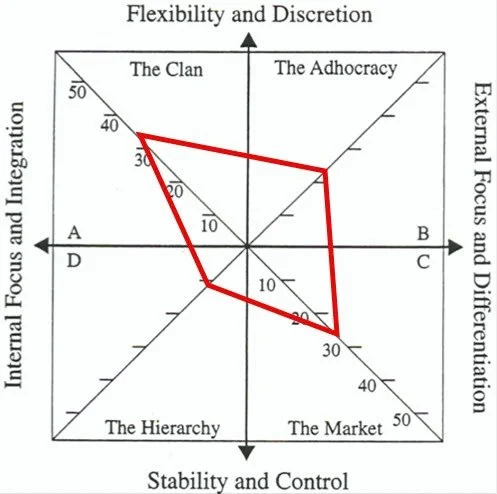
The Organizational Culture Assessment Instrument (OCAI) is used to understand an organization’s current (Now) state and its preferred state from the viewpoint of the Competing Values Framework (Cameron & Quinn, 2011).
The "Collaborate vs. Compete" Duality
TPU's two main dominant cultural archetypes were the Clan and Market Culture.
Collaborate (Clan Culture): Dominant in the Curriculum Department, emphasizing teamwork, shared goals, and a family-like atmosphere.
Compete (Market Culture): Dominant in Admissions and Marketing, focused on aggressive enrollment targets and financial results.
Critical Gap: Low Control
The assessment identified a significant deficiency in the Control (Hierarchy) quadrant. While the lack of bureaucracy keeps the organization agile, it has resulted in a "wild west" operational environment. Interviews confirmed that standards and processes are inconsistent across campuses, and procedures are rarely clearly defined.
The Retention Paradox
While leadership is viewed as transparent and accessible (leveraging town halls and clear KPIs), TPU faces a unique retention challenge. The organization acts as a talent incubator for its parent company, Big Power. As TPU staff develop expertise, they are frequently recruited back into the field by Big Power for higher wages, creating a cycle of turnover that disrupts long-term strategic continuity.
Key
Observations
Based on the Current State analysis, there are several key observations about Top Power University:
TPU’s greatest strength is its targeted, high-quality linework education.
Industry trends show an increase in the need for lineworkers over the next decade, particularly where TPU has campuses.
The current uncertainty regarding changes to the Department of Education will likely affect TPU less than many of its competitors, due to TPU’s students not using Federal Student Aid. However, changes to the Department of Veterans Affairs potentially could have a major impact on the organization, as approximately 20% of its revenue comes from students using the GI Bill.
TPU’s leadership culture places a high value on collaboration. TPU provides a strong Employee Experience to attract top instructor and curriculum developer talent. However, the organization still faces potential retention issues due to poaching from Big Power Services.
There is a lack of common standards and processes in certain areas of the organization, specifically between campuses and the intake processes for the Curriculum Department.
Future State Analysis
Purpose
The future state analysis builds on the current state analysis to guide long-term strategic planning and organizational development.
Goal
Position TPU for sustained success in a rapidly changing industry landscape.
Frameworks & Models
To move beyond simple forecasting, my team utilized multiple frameworks for strategic planning. These included the BANI framework to identify organizational weaknesses, Weak Signal Analysis to identify overlooked data, and the Strategy Diamond to validate the proposed strategy.

-
The BANI framework is an update of the well-known VUCA (Volatile, Uncertain, Complex, Ambiguous) model developed by the US Army War College in the late 1980s to describe the geopolitical landscape after the Cold War (Cascio, 2020). VUCA became a key framework for business leaders navigating new factors like globalization and the digital revolution.
In 2018, futurist Jamais Cascio noted that the world had moved beyond the constraints of the original model. Driven by climate change, the COVID-19 pandemic, and AI disruption, the world has changed greatly since VUCA was developed. To describe these new factors, Cascio introduced the BANI framework.
BANI is an acronym that describes an environment of extreme instability and the emotional/psychological impact it has on people and systems.
B - Brittle
Systems that appear strong but can shatter suddenly without warning. A brittle system lacks resilience and flexibility.
A - Anxious
The pervasive sense of helplessness and fear generated by constant change and information overload. In a BANI world, people feel they are always on the edge of the next crisis.
N - Non-linear
Cause and effect are no longer directly proportional or predictable. Small decisions can have devastating global consequences, while massive efforts might yield no results.
I - Incomprehensible
Events are so illogical and rapid that they defy human understanding. Even with massive amounts of data, the sheer noise makes it impossible to grasp the full picture.
-
Weak signal analysis is a methodology used by organizations to identify early, faint signs of emerging changes that could disrupt the status quo of the organization (Dufva, 2019). While trends show what is changing, weak signals highlight what could change in the future. A weak signal is a first symptom of change or an emerging phenomenon.
Weak signals encourage organizations to imagine radically different alternative futures. Because weak signals often seem absurd or irrelevant initially, they force organizations to confront blind spots and expand boundaries.
By monitoring and interpreting weak signals, an organization can move from reacting to change to anticipating it. This should improve its long-term resilience and strategic readiness.
-
Hambrick and Fredrickson (2005) argue that many leaders mistakenly define strategy as ambition (for example, "We want to be the number one provider"). A strategy is not a goal. It is a set of choices that positions the organization to achieve those goals.
To ensure a strategy is complete, it must answer five specific questions. If any element is missing, the strategy is fragmented and likely to fail.
Arenas: Where will we be active?
This is the key fundamental choice. It requires specificity regarding product categories, market segments, geographic areas, and core technologies. It also requires deciding where not to be active.
Vehicles: How will we get there?
These are the means for attaining the necessary presence in the arenas.
Examples: Internal development (organic growth), joint ventures, licensing, or acquisitions.
Differentiators: How will we win in the marketplace?
This defines the competitive advantage. It explains why customers will choose you over competitors.
Staging: What will be the speed and sequence of moves?
Strategy is dynamic, not static. This element addresses the timing.
Economic Logic: How will we obtain our returns?
This explains how the other four elements add up to a profitable business model.
Environment Interpretation
My team utilized Cascio’s BANI framework (2020) to interpret the external environment. This tool allowed us to move beyond risk management and identify where TPU’s current model was at risk, revealing specific areas for strategic intervention.
BANI Framework
Brittle
Observation: TPU appears robust due to high enrollment, but the revenue model is single-channel. It relies almost exclusively on student loans and GI Bill funding. A single policy change at the VA or Dept of Education could severely impact revenue.
Opportunity: The Future State can build resilience by diversifying into a revenue stream that is immune to education policy changes.
Anxious
Observation: The Current State Analysis revealed a "wild west" operational environment (Low Control) with a dominant Clan culture.
Opportunity: The Future State can reduce organizational anxiety by implementing a proposed GenAI Knowledge Management tool. This provides the system of record that the organization lacks, allowing staff to rely on a database rather than tribal knowledge.
Non-Linear
Observation: The relationship with the parent company, Big Power, is currently a resource drain for TPU.
Opportunity: The organization should look for ways to invert the disproportionate relationship by leveraging this cost-saving measure as a revenue generator.
Incomprehensible
Observation: The energy sector is heavily regulated, and inconsistent shifts in government policy (Department of Energy, Department of Education, Department of Veterans Affairs) are making strategic planning reactive rather than predictable.
Opportunity: Instead of building a rigid curriculum to meet today's regulations, build an adaptable knowledge management infrastructure that enables real-time updates to compliance standards.
Weak Signal Analysis
After using the BANI framework, we sought data points indicating a new future state for the organization. The team applied a weak signal analysis (Dufva, 2019) to the operational noise identified in the Current State.
The Signal
The team tracked a pattern in which Big Power asked TPU’s Curriculum Department to develop training content for the larger organization, leading to a new team within the department.
What If?
Other energy organizations outside the region where TPU need the same kind of training.
Insight
This signal showed a market need. It indicates there is a market for the documentation TPU already produces.
Competitive Advantage
TPU’s core competency is technical knowledge dissemination.
Insight
TPU’s ability to research, identify, and deliver critical content is what allows it to command premium tuition prices in the market. It is not just a technical college, but a knowledge center in the market.
Big Power utilizes TPU to develop internal technical writing and training materials. This is scalable and a service that can be provided to other companies outside of Big Power's markets.

Future State Vision & Strategy
After a comparative evaluation of several options for organizational strategy, expanding services to energy organizations was the most viable strategy. The plan includes first expanding by providing the current courses developed by TPU for Big Power, eventually expanding to providing a SaaS service in the field using an AI knowledge management system. This path offers several advantages:
It aligns with TPU’s existing curriculum development expertise.
It diversifies revenue streams beyond traditional tuition models.
It positions TPU as a leader in the emerging intersection of field knowledge and AI-driven tools.
It builds on current content developed for TPU’s parent organization, Big Power.
This strategy reflects the principles outlined by Harvard Business Review (2022), emphasizing that successful strategic growth builds on core capabilities while expanding into adjacent markets.
This strategy also appears viable based on the Strategy Diamond framework.
Arenas: Corporate L&D (B2B) within the energy sector.
Vehicles: Internal Development
Differentiators: Speed & Accessibility
Staging: Phased Rollout
Economic Logic: Software as a Service (SaaS) Revenue.
Action Plan
Objective
Transition TPU from a technical college to a comprehensive Educational Service Provider.
Approach
Phased Implementation from training organization to SaaS knowledge vendor.
Critical Success Factors
Maintain dedicated academic curriculum teams alongside the new corporate training teams
Use a phased approach to major investments before committing resources to software development and SaaS infrastructure.
Define and monitor key metrics at each stage.

References
California lineman apprenticeships and training. (n.d.). Lineman Central. https://www.linemancentral.com/states/california. Retrieved 2025, January 29.
.Cameron, K.S. and Quinn R.E. (2011). Diagnosing and changing organizational culture: Based on the competing values framework (Third Edition). Jossey-Bass: San Francisco, CA.
Cascio, J. (2020, April 29). Facing the age of chaos. Medium. Retrieved from https://medium.com/@cascio/facing-the-age-of-chaos-b00687b1f51d
Dave, P (2025, February 3). Using Feedback To Cultivate A Culture of Continuous Improvement. https://boisestate.zoom.us/rec/share/LJNq2yBpilxV32Kjn4DHsxgVS6JHulf4bzQL4h8D6ljBLwmsktnjBajhaxPE-APe.q4BHBGX8dt0ddlpV?startTime=1738630915000.Retrieved 2025, February 4.
Dufva, M. (2019). Weak signals in organizational futures learning. Futures, 108, 16–28.
Idaho lineman apprenticeships and training. (n.d.). Lineman Central. https://www.linemancentral.com/states/idaho. Retrieved 2025, January 29.
The Committed Innovator: The core attributes of the innovative mindset. (2023, May 2). McKinsey & Company. https://www.mckinsey.com/capabilities/strategy-and-corporate-finance/our-insights/the-committed-innovator-the-core-attributes-of-the-innovative-mindset
Harvard Business Review. (2022, February 23). What Is Strategy? It’s a Lot Simpler Than You Think [Video]. YouTube. https://www.youtube.com/watch?v=o7Ik1OB4TaE.
The Innovation Show with Aidan McCullen. (2023, December 22). Driving innovation from within Kaihan Krippendorff [Video]. YouTube. https://www.youtube.com/watch?v=AcMiPquqRUM.
McKinsey & Company. (2024, September 10). What is Leadership? https://www.mckinsey.com/featured-insights/mckinsey-explainers/what-is-leadership. Retrieved 2025, January 29.
Pandey, E. (2024, April 14). Trades make a comeback with Gen Z workers. Axios. https://www.axios.com/2024/04/14/gen-z-trade-school-vocational-training. Retrieved 2025, January 29.
Sanchez, O. (2023, May 8). Trade programs — unlike other areas of higher education — are in hot demand. The Hechinger Report. https://hechingerreport.org/trade-programs-unlike-other-areas-of-higher-education-are-in-hot-demand/. Retrieved 2025, January 29.
Silber, K. H., & Kearny, L. (2006). Business perspectives for performance technologists. In J. A. Pershing (Ed.), Handbook of human performance technology: Principles, practices, and potential (3rd ed., pp. 55–81). Pfeiffer.
Technical Education Post. (2024, November 14). Trade School Enrollment Surges. Technical Education Post. https://www.techedmagazine.com/trade-school-enrollment-surges/. Retrieved 2025, January 29.
Texas lineman apprenticeships and training. (n.d.). Lineman Central. https://www.linemancentral.com/states/texas. Retrieved 2025, January 29.
U.S. Bureau of Labor Statistics. (2024, August 29th). US BLS. https://www.bls.gov/ooh/installation-maintenance-and-repair/line-installers-and-repairers.htm . Retrieved 2025, February 1.
Van Vulpen, E. (2024, February 2). Employee Experience: A Complete Guide for HR. AIHR. https://www.aihr.com/blog/employee-experience-guide/
Woods, P. (2025). Strategic Foresight and Future of Work [Presentation and PowerPoint slides]. Boise State University. https://drive.google.com/file/d/1IIbZeVA42eBvaOSzRCETflxfwnxyuYwq/view.