
Organizational Culture Assessment
General Services
Organization: General Services Organization
Organization Type: Regional Professional Services Firm
Note: This assessment was created for Boise State’s OPWL 571 Leadership, Culture, & Systems course. General Services Organization is a pseudonym. Identifiable details and key information were anonymized.
Overview
I completed a comprehensive organizational culture assessment of a long-established regional professional services firm, integrating four established frameworks to diagnose cultural dynamics, identify systemic misalignments, and recommend strategic shifts. The analysis examined the relationship between the firm's stated mission and values, its observed structures and behaviors, and the underlying assumptions driving day-to-day decisions with particular focus on where misalignment between stated values and operational reality was producing unintended consequences for organizational effectiveness, employee retention, and long-term competitiveness.
Why an Integrated Framework Approach?
No single framework adequately captures organizational culture, and each of the major frameworks has a blind spot that another addresses. Schein's model exposes the layered relationship between visible artifacts and unconscious assumptions, but doesn't trace how those assumptions propagate through structures and time. Systems Thinking traces those propagations and identifies reinforcing loops, but doesn't quantify cultural orientation against established types. The Competing Values Framework provides an orientation when assessed using the OCAI, but doesn’t show the structures and processes like Systems Thinking. My assessment integrated all four to triangulate the diagnosis, with each framework addressing a different question: what is the culture, how does it operate, where does it sit, and where should it shift?
Frameworks Applied
-
Maps the firm's artifacts (visible structures, processes, observed behaviors), espoused beliefs and values (stated mission, ideologies, public commitments), and basic underlying assumptions (the unconscious, taken-for-granted beliefs driving behavior).
-
Trace how the firm's shared vision moved through systemic structure, patterns of events, and discrete events — and where reinforcing loops were producing outcomes inconsistent with the firm's stated intentions.
-
Plot leadership orientation across four cultural quadrants: Collaborate (Clan), Create (Adhocracy), Control (Hierarchy), and Compete (Market).
The Organizational Culture Assessment Instrument (OCAI) used the CVF to quantify the firm's current ("Now") and preferred states across six dimensions of organizational culture.
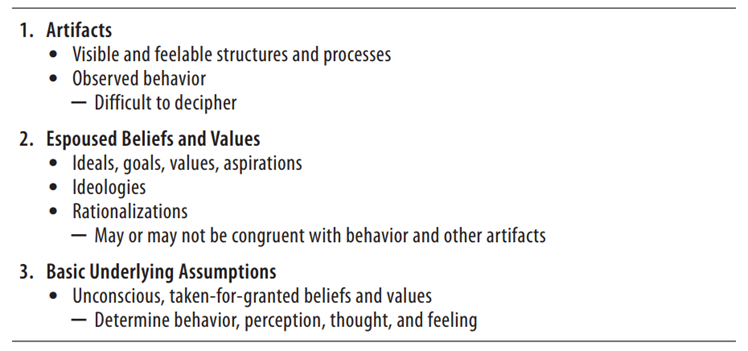
Schein, 2017, p. 18
Key Findings
The analysis identified a Fixes That Fail systems archetype operating across multiple areas of the organization. The archetype occurs when a fix successfully addresses a problem symptom in the short term but produces an unintended consequence after a delay, which reinforces the underlying problem and creates pressure to apply the fix again. In this organization, short-term accommodations to high-status stakeholders were resolving immediate symptoms while producing structural inefficiencies elsewhere. Because the accommodations succeeded in the short term, the underlying patterns were reinforced rather than addressed. The result was a culture that publicly espoused collaboration and teamwork while operationally producing siloed work, inconsistent process enforcement, and growing disengagement among portions of the workforce.
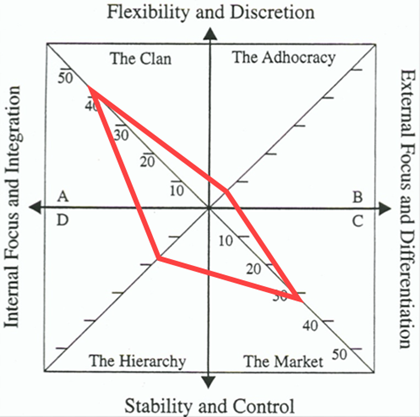
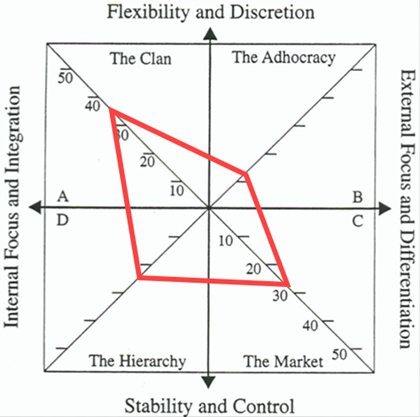
Current and Future State diagrams, adapted from Cameron and Quinn (2011, Figure 4.1, p. 76)
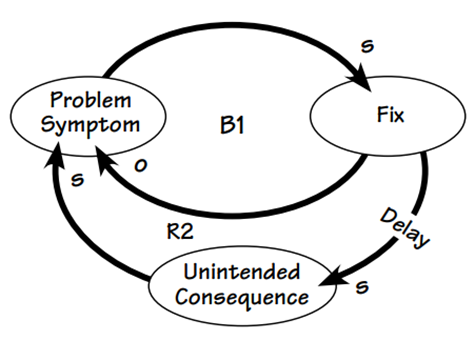
Kim, 2000, p. 20
The OCAI assessment confirmed the pattern quantitatively. The firm's current state showed strong concentration in the Collaborate and Compete quadrants, which is consistent with a culture that values both internal cooperation and external positioning. However, the firm showed limited presence in Create (innovation, adaptability) and Control (process discipline, operational rigor). The preferred state called for moderate increases in both Create and Control without significantly diminishing the Collaborate and Compete strengths that the firm had built its reputation on.
The deeper finding was a two-tier cultural system: leadership applied different cultural orientations to different employee groups, with one group operating under Collaborate-Compete conditions (autonomy, development investment, flexible expectations) while another operated under Compete-Control conditions (process standardization, restricted flexibility, outcome-focused evaluation). This kind of bifurcation matters analytically because culture is not experienced uniformly across an organization, and aggregate cultural assessments can mask within-organization variance. Interventions targeted at "the culture" without recognizing the bifurcation tend to fail, because they address an aggregate that doesn't reflect anyone's actual experience. The two-tier finding explained several patterns the firm was struggling to address — retention difficulties in specific employee categories, inconsistent policy enforcement, and growing tension between stated values and lived experience for a meaningful portion of the workforce.
Recommendations
The assessment produced twelve proposed shifts to the firm's basic underlying assumptions, paired with seven supporting change management activities. The recommendations were structured to preserve what the firm did well (collaboration, mentorship culture, reputation-driven client work) while addressing the structural issues the analysis surfaced.
Representative shifts in basic underlying assumptions:
That all employees, not just one category, contribute value to organizational success
That development and growth opportunities should be available across roles rather than concentrated in one employee group
That collaboration should extend across departments and functions, not only within the firm's existing high-status practice areas
That modernization and innovation can complement traditional organizational structures rather than threaten them
That competitive compensation and evaluation parity drive retention and reduce the cost of turnover
Representative supporting change management activities:
Redesign of staff management structure to provide consistent reporting relationships
Documentation of professional development pathways across role categories
Compensation and evaluation parity adjustments
Formation of an innovation committee to evaluate technology and process improvements
Increased cross-functional leadership meetings to reduce siloing and identify duplication
Each recommended assumption shift was paired with the structural or process change required to make the shift visible and operational. The framing throughout was that culture change without structural reinforcement reverts; the supporting activities were therefore essential, not optional.
Methodology
The four frameworks were applied in sequence to produce the integrated analysis. Schein's levels were mapped first to establish the cultural baseline and identify the firm's basic underlying assumptions. Systems Thinking was then applied to trace how those assumptions propagated through systemic structure, patterns of events, and discrete events, which surfaced the Fixes That Fail dynamic and other reinforcing loops. The OCAI was administered separately using the standard six-dimension instrument to quantify the firm's current and preferred states, and the CVF was used to interpret the OCAI scores in the context of the qualitative analysis already developed. Pohl's Stages of Growth model provided additional context for situating the firm's challenges within a broader organizational lifecycle, distinguishing stage-typical difficulties from firm-specific ones.
Deliverable
A report including an integrated framework application, full OCAI assessment with scoring tables and current-vs-preferred state mappings across all four CVF quadrants, qualitative analysis of each cultural dimension, twelve proposed assumption shifts with supporting rationale, and seven detailed change management activities with implementation considerations.
Note on availability: The full report is unavailable for distribution due to the identifiability of the subject organization and the sensitive nature of the cultural analysis.
References
Cameron, K. S., Quinn, R. E., & DeGraff, J. (2022). Competing values leadership. Edward Elgar Publishing Limited.
Kim, D. H. (2000). Systems thinking tools: a user’s reference guide. Pegasus Communications.
Pohl, M. (2024). Business growth framework: creating organizational alignment to pursue growth. The ReWild Group.
Scott, G. and Winiecki, D.J. (2012). Synthesizing soft systems methodology and human performance technology. Performance Improvement Quarterly, 25(3), 81-105.
Schein, E. H. (2017). Organizational culture and leadership. John Wiley & Sons.